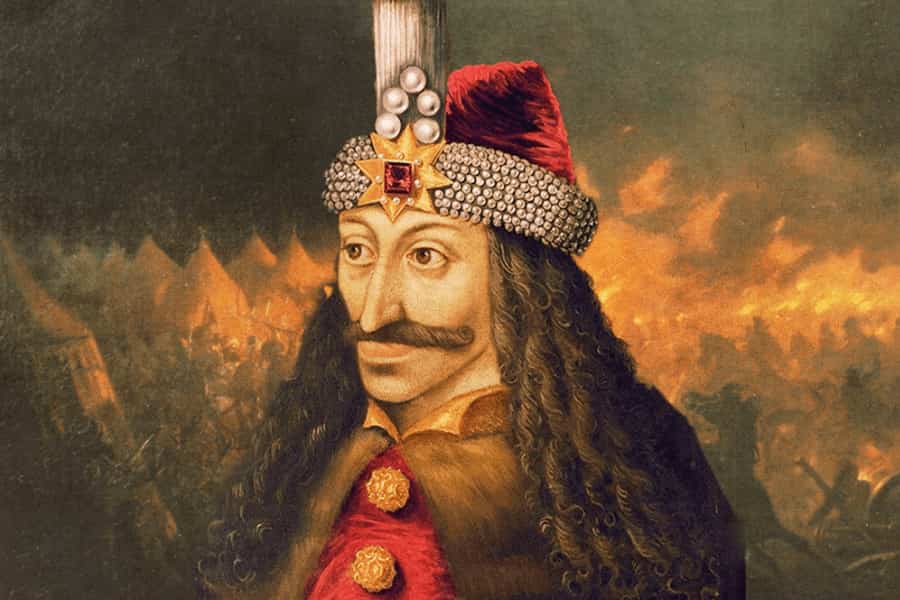
Vlad III ruled Wallachia during the 1400s and became known for his brutal methods of dealing with enemies. His real story involves political survival, warfare against the Ottoman Empire, and violent tactics that earned him a dark reputation across Europe.
Who Was Vlad the Impaler?
Vlad III was born around 1431 in Transylvania. His father was Vlad II Dracul, a member of the Order of the Dragon, which is where the family name “Dracula” came from. The word “dracul” means dragon in Romanian, but it also means devil.
You should know that Vlad signed his own letters as “Dragulya” or “Drakulya” in the 1470s. He became the prince of Wallachia, which is part of modern-day Romania, three separate times during his life. His reign was marked by constant fighting to keep his throne.
Vlad spent part of his youth as a prisoner of the Ottoman Turks. This experience shaped his later hatred of the Ottoman Empire and influenced his cruel approach to warfare and punishment.
The Historical Context of 15th Century Wallachia
Wallachia sat between two powerful forces in the 1400s. The Ottoman Empire pushed from the south while the Kingdom of Hungary pressed from the north. You can imagine how difficult it was to maintain independence between these giants.
The region’s princes faced constant threats from several directions:
- The Ottoman Empire demanding tribute and loyalty
- Hungarian kings seeking control over the territory
- Local nobility plotting to take power
- Vlad’s own brother competing for the throne
Being a ruler in Wallachia meant fighting for survival every single day. The position of prince wasn’t stable, and leaders changed frequently through violence and betrayal. Vlad grew up in this world of backstabbing and warfare, which taught him that showing weakness meant losing everything.
Fact Versus Fiction: Separating Myth from Reality
Many stories about Vlad the Impaler mix truth with exaggeration. He really did use impalement as his preferred method of execution, which is how he got his nickname “Tepes” (the Impaler). This wasn’t just propaganda from his enemies.
However, some tales grew larger over time. Stories circulated throughout Europe about forests of impaled victims and dinner parties among the dying. While Vlad was genuinely brutal, some accounts were likely spread by his political enemies to damage his reputation.
The connection between Vlad and Bran Castle is mostly fiction. Historical records suggest Vlad might have been held prisoner at Bran Castle briefly before being moved to Budapest. His actual stronghold was at Poenari Castle, not Bran.
Bram Stoker borrowed the Dracula name and some Transylvanian setting details for his 1897 novel. But the vampire character wasn’t based on detailed research about Vlad’s actual life. The connection between the historical prince and the fictional vampire is much looser than most people think.
Vlad the Impaler’s Reign and Reputation
Vlad ruled Wallachia three times between 1448 and 1476. His most significant reign lasted from 1456 to 1462. During this time, he fought hard against Ottoman expansion and tried to unite his fractured territory.
His methods were extreme even by medieval standards. Vlad impaled thousands of people, including Ottoman prisoners, Wallachian nobles who opposed him, and criminals. He believed that extreme cruelty would scare his enemies and keep order in his land.
Some people in Wallachia saw him as a protector against the Ottomans. Others viewed him as a tyrant who went too far in his quest for power. Your perspective on Vlad probably depended on whether you were his ally or enemy.
Diplomatic reports from the 1400s already called him “Dracula” or “Drakula.” These documents described his violent acts and the fear he inspired across the region. His reputation for cruelty spread throughout Europe during his own lifetime, not just in later centuries.
Bran Castle’s Connection to Vlad the Impaler

Most historians agree that Vlad the Impaler never actually lived in Bran Castle, despite the popular myths connecting the two. His real connection to the fortress was minimal, limited to military campaigns in the surrounding area and possibly a brief imprisonment.
The History of Bran Castle
Bran Castle stands on a rocky precipice in Transylvania, commanding views of the surrounding landscape. The fortress was built in the 14th century and served as a strategic point for controlling the border region.
The castle was never under Vlad’s rule. In fact, it wasn’t a friendly place for him to visit at all. The Princes of Transylvania controlled the fortress and asked Vlad to handle anti-Ottoman resistance at the border through an alliance.
Vlad’s actual residence was Poenari Castle, a cliff-side fortress requiring a climb of 1,480 steps. This remote citadel was far different from Bran and served as his true home base during his reign as Prince of Wallachia in the 15th century.
Legends Linking Vlad the Impaler to Bran Castle
The belief that Vlad was imprisoned at Bran Castle for two months after his capture by the Hungarians in 1462 has been debunked by modern historians. Evidence now suggests he was actually held in a different prison near Budapest.
Vlad’s only real connection to Bran was through his military campaigns in the area. He fought numerous battles around the castle during the 15th century as part of his resistance against Ottoman expansion. These brief military encounters became the foundation for much larger legends.
The association between Vlad and Bran Castle grew over time, fueled by the popularity of Bram Stoker’s 1897 novel Dracula. Stoker, an Irish writer, never visited Transylvania and likely never knew about Bran Castle specifically.
Modern Popularity and Tourism
Today, Bran Castle is one of Romania’s most popular tourist destinations. The castle is marketed as “Dracula’s Castle” to attract visitors interested in gothic fiction and vampire stories.
You can visit the castle and explore its rooms, towers, and courtyards. The fortress benefits from its mystical connection to the Dracula legend, even though historians recognize this connection as largely exaggerated.
The castle draws fans of vampire stories from around the world. Its dramatic location and gothic appearance make it easy to see why people associate it with Stoker’s fictional vampire count, even without historical accuracy.
Cultural Impact and Dracula Mythos
Bran Castle resembles Castle Dracula as described in Stoker’s novel, with both standing on rocky precipices. This visual similarity has cemented the castle’s place in popular culture, regardless of historical facts.
The connection to Vlad the Impaler is shrouded in mysteries and legends that continue to fascinate visitors. While Vlad never ruled over the fortress, his reputation for cruelty and his use of impalement against enemies made him the perfect inspiration for Stoker’s vampire character.
Romania’s tourism industry embraces this mystical connection. The castle offers you a journey through European history mixed with Hollywood fiction, creating an experience that blends reality with legend.